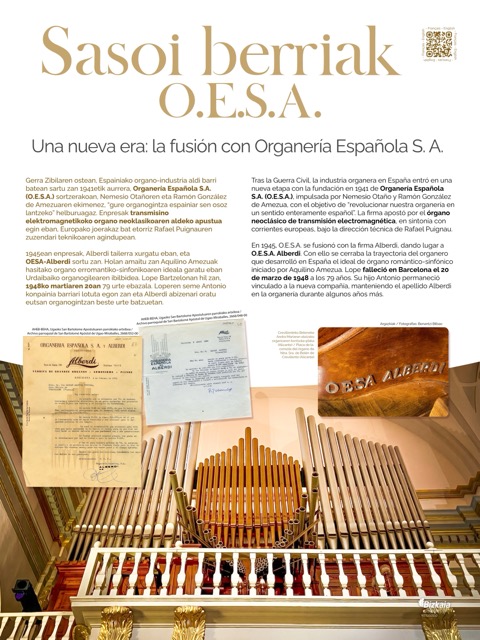
A New Era: The Merger with Organería Española S.A.
Following the Civil War, the organ building industry in Spain entered a new phase with the founding of Organería Española S.A. (O.E.S.A.) in 1941. Driven by Nemesio Otaño and Ramón González de Amezua, its goal was to «revolutionize our organ building in an entirely Spanish sense.» The company shifted towards the neoclassical organ with electro-magnetic action, in line with European trends, under the technical direction of Rafael Puignau.
In 1945, O.E.S.A. absorbed the Alberdi firm, giving rise to O.E.S.A.-Alberdi. This brought to a close the career of the organ builder who had developed in Spain the ideal of the Romantic-Symphonic organ, initiated by Aquilino Amezua. Lope died in Barcelona on March 20, 1948, at the age of 79. His son Antonio remained associated with the new company, keeping the Alberdi name alive in organ building for a few more years.
Une nouvelle ère: la fusion avec Organería Española S.A.
Après la guerre civile, l’industrie de la facture d’orgues en Espagne entra dans une nouvelle phase avec la fondation en 1941 de Organería Española S.A. (O.E.S.A.), impulsée par Nemesio Otaño et Ramón González de Amezua, dans le but de « révolutionner notre facture d’orgues dans un sens entièrement espagnol ». L’entreprise s’orienta vers l’orgue néoclassique à transmission électromagnétique, en accord avec les courants européens, sous la direction technique de Rafael Puignau.
En 1945, O.E.S.A. absorba la maison Alberdi, donnant naissance à O.E.S.A.-Alberdi. Avec cela se clôturait la trajectoire du facteur d’orgues qui avait développé en Espagne l’idéal de l’orgue
romantique-symphonique initié par Aquilino Amezua. Lope mourut à Barcelone le 20 mars 1948, à l’âge de 79 ans. Son fils Antonio resta lié à la nouvelle compagnie, maintenant le nom Alberdi dans la facture d’orgues pendant encore quelques années.