Consolidating an Independent Firm
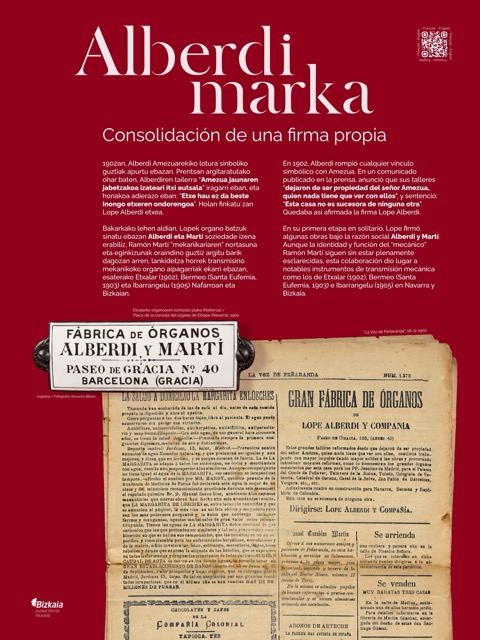
In 1902, Alberdi severed all symbolic ties. In a statement published in the press, he announced that his workshops «had ceased to be the property of Mr. Amezua, who no longer has anything to do with them,» and asserted: «This firm is the successor to no other.» Thus, the Lope Alberdi firm was officially founded.
During his initial solo phase, Lope signed certain instruments under the company name Alberdi y Martí. Although the exact identity and role of the «mechanic» Ramón Martí remain somewhat unclear, this collaboration gave rise to remarkable instruments with mechanical action, such as those in Etxalar (1902), Ibarrangelu (1905), and Lumo (1906), located in the Basque Country and Navarre.
Consolidation d’une entreprise indépendante
En 1902, Alberdi rompit tout lien symbolique. Dans un communiqué publié dans la presse, il annonça que ses ateliers « avaient cessé d’être la propriété de M. Amezua, qui n’a plus rien à voir avec eux », et affirma : « Cette maison n’est le successeur d’aucune autre ». La maison Lope Alberdi était ainsi officiellement fondée.
Dans sa première étape en solitaire, Lope signa certaines œuvres sous la raison sociale Alberdi y Martí.Bien que l’identité et le rôle du « mécanicien » Ramón Martí ne soient pas encore entièrement clarifiés, cette collaboration donna naissance à des instruments remarquables
à transmission mécanique, comme ceux d’Etxalar (1902), Ibarrangelu (1905) et Lumo (1906), au Pays basque et en Navarre.